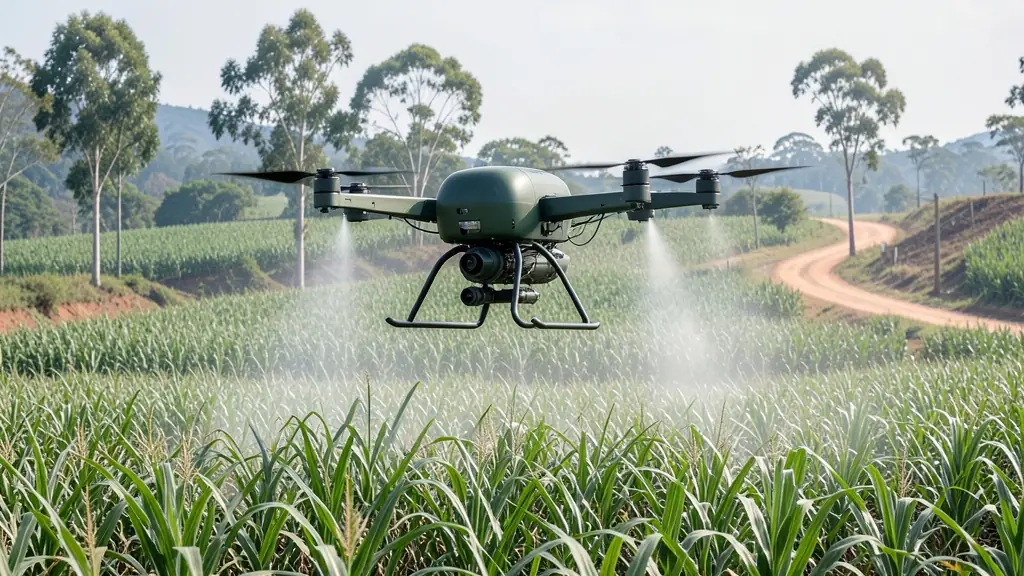
Drone spraying puts fungicide, insecticide, herbicide or foliar feed onto crops from a few metres above the canopy, without a tractor in the lands or a crop-spray aircraft overhead. South African farmers use it on sugar cane, maize, soya, citrus, macadamias, vineyards, vegetables and pasture, and on wet or steep lands where ground rigs cannot go. It is quoted per hectare and must be done by a licensed operator with the right spraying approvals. Send one request and drone spraying operators in your area quote you directly. It is free and there is no obligation.
When drone spraying makes sense
A spray drone does not replace every boom sprayer, but it suits some jobs very well:
- Wet, steep or tall crops: fields where a tractor would bog down, damage the crop or tip over, such as cane on slopes.
- Spot and patch spraying: treating only the problem area of a field, often guided by a crop health map.
- Orchards and vineyards: rows that need targeted cover without driving between them after rain.
- Small or awkward lands: blocks too small or irregular for a crop-spray aircraft.
Spray drones carry a tank of roughly 10 to 50 litres and fly short sorties, so large farms may still be faster by air or ground rig. To buy your own, see agricultural drones.
Approvals, products and drift
Spraying crops by drone is commercial flying with extra rules. The pilot needs a Remote Pilot Licence (RPL) and the company an RPAS Operator Certificate (ROC), so ask to see them. Spraying also needs the right approvals and products registered for the crop, so ask the operator which approvals they hold for spraying, and whether the product label allows aerial or drone application at the volume they plan.
Drift is the main risk. Wind, heat and droplet size decide where the spray lands, and neighbouring crops, homes, water and beehives must be protected. A good operator checks the weather, sets buffer zones and keeps a spray record for each field.
What drives the price per hectare
Drone crop spraying in South Africa is usually quoted at about R150 to R300 per hectare for the application, with the chemical often supplied by the farmer or priced separately. Large, open, flat blocks close together sit at the low end. Small or scattered fields, steep slopes, orchards that need more water per hectare, travel to the farm and night or early morning work push it up. Ask whether a minimum charge applies and what happens if wind stops the job halfway.
Briefing operators so quotes compare
Give every operator the same facts: the crop and its height, the hectares and a map of the lands, the product and rate your agronomist recommends, the spray window, water access on the farm and anything sensitive nearby. Ask each one for their RPL, ROC and spraying approvals, their spray volume per hectare, droplet size, swath width, how many hectares they cover in a day and what records you receive afterwards. A drone survey or crop health map first can show where spraying is really needed. Operators who sell their own aircraft often also offer drone training for farm staff.
What to include in your request
- Crop, its height and the problem
- Hectares and a map of the lands
- Product and rate from your agronomist
- Spray window and water access on the farm
- Neighbours, water and hives nearby
Drone Crop Spraying for different clients
- Hobbyists and families: treating a smallholding orchard or pasture without buying a sprayer or a tractor
- Farmers and growers: fungicide, insecticide and foliar feed on maize, soya, cane, citrus and vineyards
- Estate agents and developers: weed control on large estate grounds, golf course roughs and lifestyle smallholdings
- Builders, engineers and installers: pre-development weed spraying on cleared land where vehicles cannot drive
- Mines, plants and utilities: spraying vegetation on mine rehabilitation areas, plantations and timber blocks
- Photographers, film crews and agencies: showing modern farming methods in agricultural magazines, shows and co-op days
- Security companies and estates: keeping vegetation down along long farm and plant fence lines with spot spraying
- Municipalities, schools and NGOs: invasive plant control on municipal land, wetlands and conservation areas with approval
Frequently asked questions
How much does drone crop spraying cost per hectare?
Is drone spraying legal in South Africa?
How many hectares can a spray drone cover in a day?
Who sends me the spraying quotes?
Drone Crop Spraying by province and city
- Johannesburg
- Pretoria
- Centurion
- Midrand
- Sandton
- Randburg
- Roodepoort
- Krugersdorp
- Randfontein
- Germiston
- Boksburg
- Benoni
- Kempton Park
- Alberton
- Vanderbijlpark
- Vereeniging
- Durban
- Pinetown
- Pietermaritzburg
- Richards Bay
- Newcastle
- Ladysmith
- Gqeberha (Port Elizabeth)
- East London
- Kariega (Uitenhage)
- Mthatha
- Cape Town
- Bellville
- Paarl
- Stellenbosch
- George
- Worcester
- eMalahleni (Witbank)
- Middelburg
- Secunda
- Mbombela (Nelspruit)
- Rustenburg
- Brits
- Klerksdorp
- Potchefstroom
- Mahikeng
- Polokwane
- Tzaneen
- Kimberley
- Upington
- Bloemfontein
- Welkom
- Sasolburg