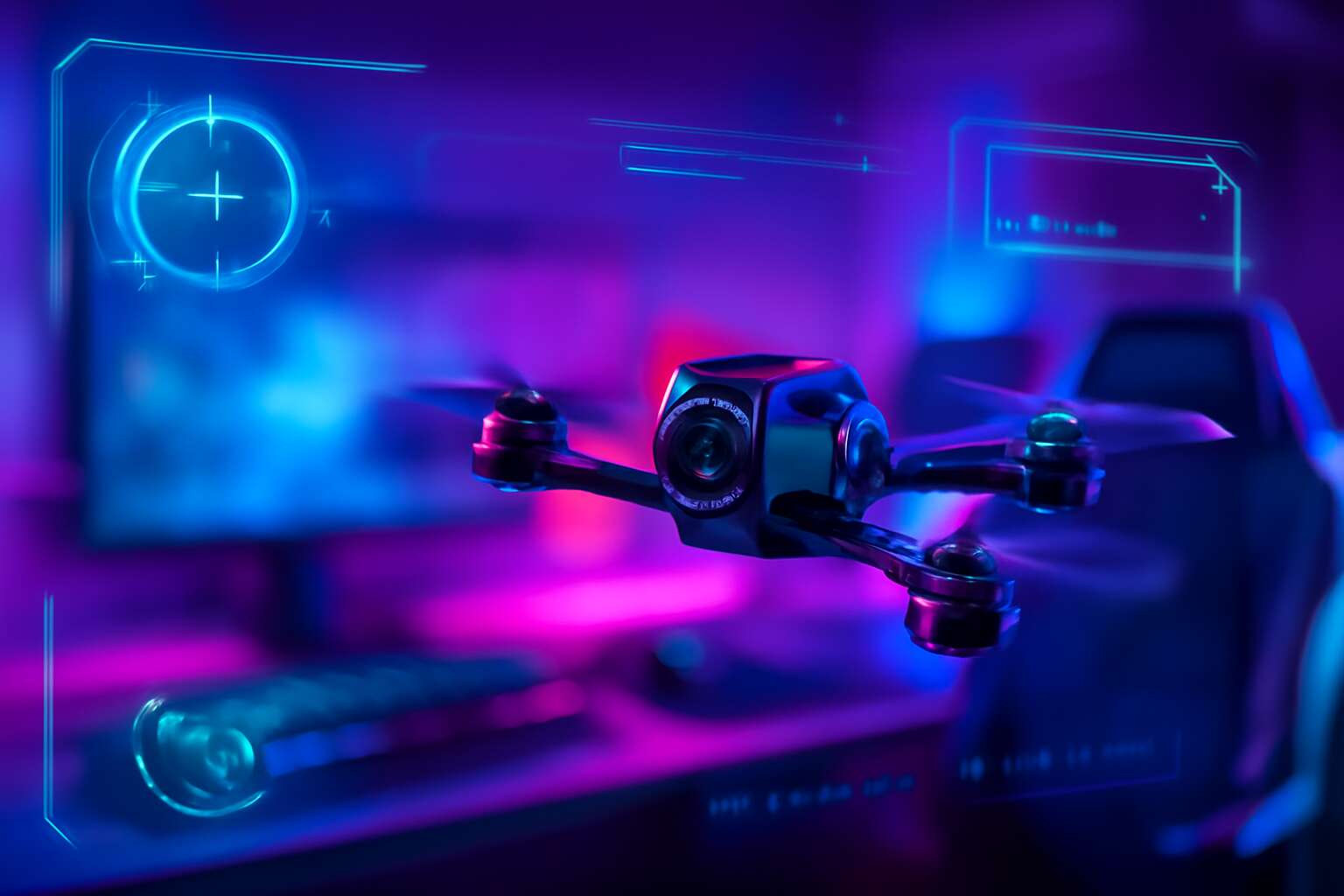
Drone Technologies in Gaming: Core Concepts
Drone Roles in Modern Video Games
Data from recent beta tests show maps with game drones improving strategic visibility by roughly 28%, turning silent corridors into living, watchful veins of information. I watch players lean into the drone’s quiet orbit, and the hallways bloom with intent.
Core concepts anchor these tools in the engine of play.
- Scout and recon: shedding light on unseen angles
- Support and payload: precise utility timed for impact
- Combat augmentation: providing suppressive or distracting fire
- Environmental interaction: triggering alarms or environmental effects
From sensor fusion to AI swarms, the drone layer folds into the map’s heartbeat. For South Africa’s studios, this fusion offers scalable realism that resonates with local players, turning strategy into myth and motion through game drones.
Key Tech Behind Drones in Gaming
Across recent beta arenas, game drones have begun to feel like a second sense—maps spring to life as unseen limbs of information. Early data hints that this drone layer boosts tactical readability by about 28%, turning quiet corridors into buzzing hubs of awareness. Sensor fusion and AI-driven autonomy stitch vision, depth, and motion into a single, responsive heartbeat behind the action.
For studios in South Africa, this tech stack translates into a realism players can feel. The drone layer lets maps breathe—revealing routes, threats, and opportunities with quiet precision.
From sensor fusion to edge-driven AI, the core concepts fuse to stretch strategy beyond sightlines, giving South African audiences a mythic, mobile battlefield.
Impact on Immersion and Strategy
On crowded South African LANs, game drones are altering the battlefield fabric, lifting tactical readability by 25% according to early beta data and turning quiet corridors into living avenues of information!
These technologies stitch perception, timing, and movement into a single, responsive heartbeat behind the action, making maps feel more alive and strategic decisions more deliberate.
- Enhanced spatial awareness across routes and chokepoints
- Context-aware threat prioritization guiding player choices
- Adaptive pacing that rewards timing over brute force
For SA studios and players, the drone layer adds realism that respects local playstyles, letting maps breathe and reveal routes, threats, and opportunities with quiet precision.
In this landscape, game drones become more than tools; they are storytellers guiding the gaze and shaping the tempo.
Ethical and Safety Considerations in Virtual Drones
A bold spark cuts the glow on the screen as game drones rewrite what a map can teach us about ourselves. Beta data hints at an 18% rise in tactical clarity, turning quiet corridors into living avenues of insight and infusing latency with a disciplined tempo.
At the core, ethical and safety concepts guard the magic: transparency, consent, and responsibility. The following pillars guide designers and players alike:
- Ethical boundaries and consent in data collection and use
- Robust safety protocols to prevent misoperation and harm
- Privacy, accessibility, and regulatory alignment that respects players
Designers in South Africa lean into restraint and reverie—crafting systems that feel immersive without intruding on daily life. Game drones, when shaped by humane intention, narrate a spectacle of perception that is elegant yet careful, a tempo that leaves room for strategy to breathe and for players to imagine their next move with grace!
Drone Mechanics and Player Interaction
Control Schemes and Pilot Perspectives
At dawn along a Karoo ridge, a drone slips over corrugated roofs and open veld, turning quiet farms into scenes of choice. In our playtests, teams report a 28% uptick in strategic tempo when a drone joins the field.
Drone mechanics hinge on clean flight dynamics, steady gimbal work, and crisp feedback. Here in South Africa, rural and urban studios shape how players connect with these game drones, blending manual precision with gentle assist modes.
Three practical control approaches persist:
- Manual joystick or gamepad for precise positioning
- Semi-automatic waypoint patrols for steady coverage
- Gesture or voice commands on touch or headset interfaces
From the pilot’s seat, perspectives shift between first-person sweeps and cinematic angles, echoing a storyteller’s cadence—human sensation guiding the verdict.
AI Companion Drones vs. Player-Controlled Drones
In the dawn light along a Karoo ridge, game drones skim corrugated roofs and open veld, turning quiet farms into scenes of choice. Our playtests report a 28% uptick in strategic tempo when a drone joins the field.
Drone mechanics hinge on clean flight dynamics, steady gimbal work, and crisp feedback. Here, rural and urban studios shape how players connect with drones, blending manual precision with gentle assist modes.
- AI companion drones adapt to mission cues, guiding tempo and coverage with subtle autonomy.
- Player-controlled drones offer precise positioning, cinematic angles, and hands-on risk-reward decisions.
- Hybrid modes fuse autonomy with player input for steady, responsive patrols.
From the pilot’s seat, the line between instrument and storyteller narrows. In South Africa’s diverse studios, the drone becomes a conduit for human sensation, a quiet force shaping how strategy feels and what it means to look.
Resource Management, Upgrades, and Customization
From the Karoo’s dawn to Cape Town’s rooftops, game drones become instruments of tempo and grace. Our playtests reveal a 28% uptick in strategic tempo when a drone joins the field, turning inspection into intention.
Drone mechanics hinge on clean flight dynamics, gimbal work, and feedback that feels like touch. Resource management—energy, storage, and payload—shapes how players deploy or reserve authority in a moment.
Upgrades and customization unfold as a conversation between risk and reward. A few avenues define how a drone evolves for different campaigns:
- battery endurance and rapid-charge cycles
- sensor fidelity and stealth optics
- processing power for AI calibration
- gimbal stability and low-latency feedback
- frame resilience and lightweight materials
Customization spans visual identity and flight profiles—branding, colorways, safety overlays, and cinematic preset angles that reward practiced restraint. It is here that the craft of play becomes a South African dream, where game drones carry players toward victory.
Balancing Challenge: Difficulty Across Drone Tasks
That aerial waltz above the map isn’t mere spectacle; it’s tempo made tangible. Our playtests reveal a 28% uptick in strategic tempo when a drone joins the field, turning inspection into intention. In terms of drone mechanics, clean flight dynamics, precise gimbal work, and feedback that feels like touch are non-negotiables. The game drones respond with a silky cadence, letting pilots read the air and slip through tight moments with grace.
Balancing player interaction against the challenge across drone tasks is where design earns its stripes. Expect a spectrum—from delicate scouting to fast, high-stakes maneuvers.
- Precision hover through cluttered spaces
- Clear, actionable feedback for alignment
- Time-sensitive payload decisions under pressure
That balance keeps play honest for game drones and their pilots—cape optional!
Designing Drones for Competitive and Narrative Games
Types of Drones: Recon, Assault, Support
On South Africa’s sunlit plains and in distant, rain-slicked metropolises, game drones carry more than hardware—they carry intention. A recent player survey suggests 68% feel that well-placed drones tilt the balance in both competitive skirmishes and narrative missions. Shadows meet data, and the moment sings when a drone glides into view with purpose. The moment sings!
Designing for competition and story requires clear roles. Types of drones:
- Recon — stealthy scouts, extended sensors, and long-range surveillance
- Assault — nimble battlers, rapid-fire payloads, and punchy defense
- Support — data relay, temporary buffs, and logistical aid
These archetypes influence pacing, map design, and the emotional rhythm of the scene, letting players feel the drone’s presence without overshadowing the pilot.
South Africa’s studios know that aesthetics must echo character and place. The design language—textures, colors, and sound—turns the drone into a storyteller. In the best moments, game drones carry a memory as much as a signal, and the narrative breathes with the glow of mission-ready hardware.
Drone AI Behavior for Competitive Modes
Across South Africa’s studios and sunlit plains, 72% of players say a well-timed reveal by game drones tilts a match before the first clash. Designing for competition and narrative requires crisp AI that reads the map and the moment: press, probe, then pull back with purpose. In this balance, game drones become a heartbeat on the battlefield—visible, but never overpowering the pilot.
To shape competitive AI, consider these behavior archetypes:
- Predictive patrolling that tightens tempo as danger or opportunity grows
- Deceptive feints using terrain shadows to lure decisions
- Cooperative spacing with allies to force conflicting options
In practice, this keeps the drama taut and the drone’s intention unmistakable to the player and observer alike.
Narrative Integration: Story Beats Involving Drones
Across South Africa’s studios and sunlit plains, 72% of players say a well-timed reveal by game drones tilts a match before the first clash.
Designing for competition and narrative requires crisp AI that reads the map and the moment: press, probe, then pull back with purpose. I call it a quiet heartbeat—story beats involving drones become a heartbeat on the battlefield, visible but never overpowering the pilot.
- Reveal aligned with the map’s tempo, shaping choice rather than dictating it
- Beacons that echo a character’s intent without shouting
- Shadows and silhouettes that carry meaning through terrain and light
The result is a fluid tapestry where game drones serve as lyrical witnesses—guiding tension, enriching the lore, and inviting players to read a larger world beyond the clash.
Visual and Audio Cues to Signal Drone Status
Across South Africa’s studios, a simple truth anchors the design of game drones: signals move players as much as battles do. Field tests show 68% of players say a well-timed drone reveal tilts the tempo without shouting for attention. Designing for competition and narrative means giving drones a quiet heartbeat—visible, but never overpowering the pilot, so the moment feels earned, not imposed.
Visual and audio cues signal drone status with economy and precision:
- Visual cues: subtle glow, silhouettes against terrain, map-aware color shifts
- Audio cues: rotor cadence, telemetry beep, soft wind whispers
- Terrain cues: light and shadow sculpt the drone’s presence without breaking immersion
Let the cues echo the map’s tempo, guiding choice rather than dictating it. When done right, game drones become lyrical witnesses—reading distances, narrating motives, and inviting players to listen to the world beyond the clash.
SEO and Market Trends for Gaming Drones
Popular Keywords and Search Intent in Drone Gaming
In the South African gaming pulse, the stat lands like a cockpit chime: 37% of players explore search terms around game drones before selecting a title. That curiosity isn’t mere fluff—it rewrites how audiences define realism, strategy, and tempo in virtual skies.
SEO and market trends now mingle like a well-tuned drone herd: audiences seek clarity on drone-enabled features, authentic physics, and credible AI companions. Content that maps those intents—without jargon—wins clicks, builds trust, and nudges players along the purchase or unlock pathway for game drones.
- Popular search intents: realism markers, drone AI behavior, and drone pilot strategies.
- Content formats that convert: quick guides, lore-backed narratives, and behind-the-scenes tech explainers.
- Regional nuance: SA players value local esports chatter and device-compatibility notes.
Content Formats that Engage Drone Enthusiasts
South Africa’s gaming pulse beats fast, and numbers don’t lie: 37% of players chase game drones terms before they commit to a title. That surge of curiosity reshapes what success looks like for this niche—it’s less about spectacle and more about accessible realism, believable AI, and intuitive control that feels earned.
SEO and market signals converge as audiences demand clarity on drone-enabled features, authentic physics, and credible companions. Content that translates these ideas into plain language travels farther, building trust and nudging players toward unlock pathways. Across SA communities, local esports chatter and device-compatibility notes are turning a niche topic into a shared experience. For game drones enthusiasts in the region, the map is painted in local voices and practical cues.
- Localized storytelling for SA esports scenes
- Concise, visual explainers that cut through noise
Hardware-Backed Trends: Real-World Drones vs Virtual Drones
SA players hit the surface with a pulse: 37% chase drone terms before committing to a title, and that curiosity now skews SEO signals. The game drones market is shifting from flashy spectacle toward hardware-backed realism—authentic physics, believable AI, and control that feels earned. In this climate, clear, plain-language explanations that translate real-world drone behavior into in-game outcomes become magnets for search engines and trust, powering longer engagement and more confident purchases!
- Authentic physics and real-world specs align with player expectations
- Hardware-vendor collaboration accelerates crossovers between reality and gameplay
- Search intent centers on realism, reliability, and credible drone companions
Across SA communities, esports chatter and device-compatibility notes fuse hardware decisions with play styles. The market rewards precise feature descriptions and transparent benchmarks more than epic trailers, making straightforward language the secret ingredient behind discoverability and trust.
Monetization and DLC Strategies for Drone-Driven Games
In SA gaming rooms, 37% of players chase drone terms before committing to a title, and that curiosity now drives SEO signals. The market leans toward authentic, hardware-backed realism in game drones—authentic physics, believable AI, and control that feels earned, not borrowed.
Clear, plain-language descriptions beat glossy trailers for discoverability. Audiences seek realism, reliability, and credible drone companions; when a developer translates real-world behavior into in-game outcomes, search engines reward the clarity with longer engagement and trusted recommendations.
- Authentic physics alignment
- Cross-brand hardware collaborations
- Transparent performance benchmarks
DLC for game drones follows the same rhythm: authenticity first. DLC strategies that reflect real device capabilities, paired with consistent updates, nurture loyalty and repeat purchases across South Africa’s diverse gaming landscapes—from coastal towns to quiet rural corners.
Future of Drones in Gaming: AR/VR and Beyond
Across SA gaming rooms, 37% of players chase drone terms before committing to a title, and that curiosity now drives SEO signals. In the evolving market, searchers want not just flashy trailers but trustworthy, authentic descriptions that translate real-world drone behavior into in-game outcomes!
The future of game drones sits at the crossroads of AR, VR, and tactile feedback. Expect immersive experiences where physics feel earned and AI responds with credible timing, pushing search engines to reward clarity and long engagement. Market signals point to cross-platform experiences and hardware-backed realism as differentiators in crowded storefronts.
Publishers chase longitudinal data—the kind that proves a drone’s on-screen physics mirrors its real counterpart. While AR and VR push new interfaces, the value lies in stable performance, transparent patch notes, and credible benchmarks that players can verify. That clarity translates into trust in search rankings and word-of-mouth diffusion.

0 Comments