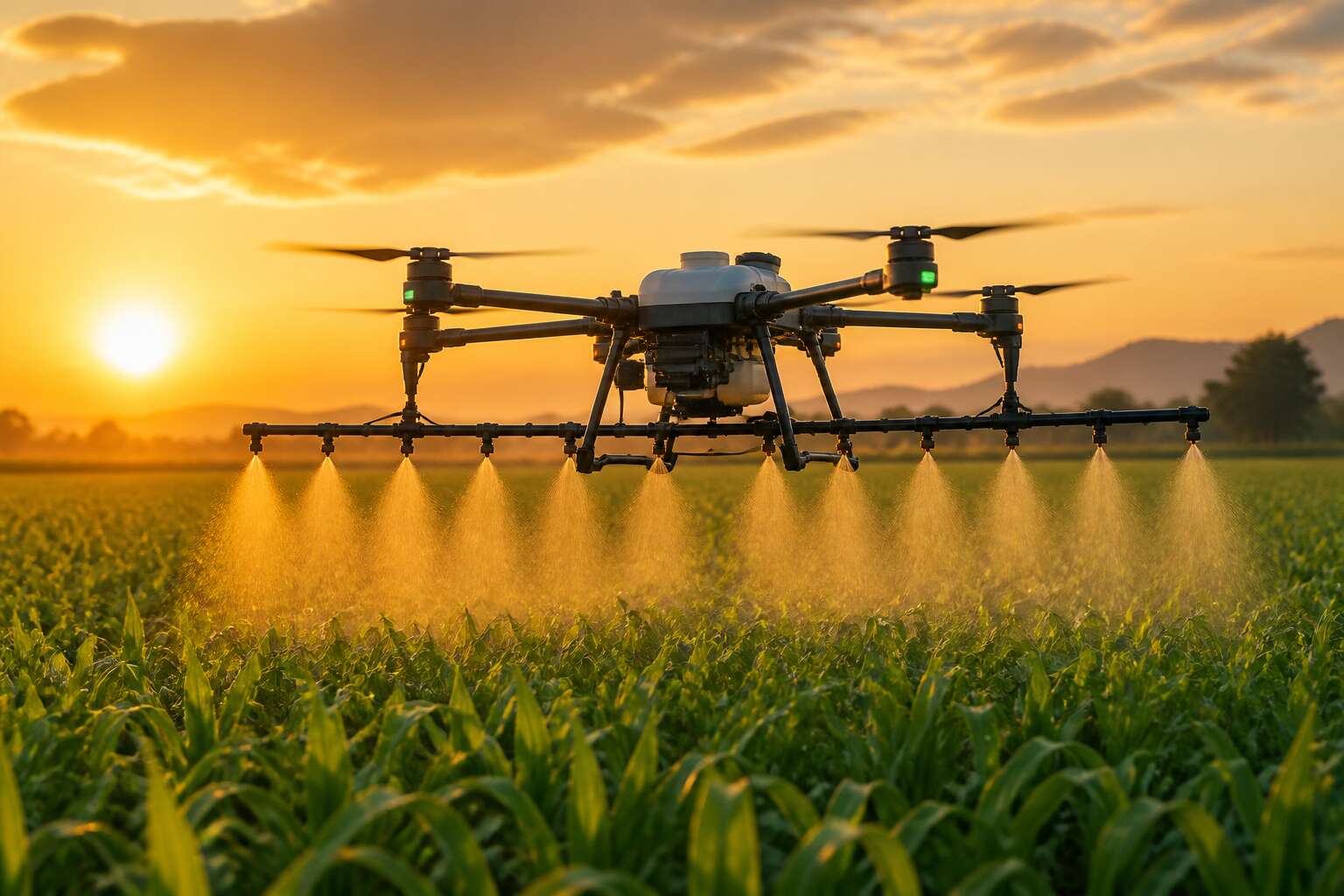
The Evolution of Aerial Spraying Drones
From Manned Aircraft to Unmanned Aerial Systems
South African agriculture once trusted crop protection to manned aircraft. Pilots flew low over maize fields, dodging pylons and reading the wind by feel. That approach worked, but it was costly and carried real danger. Unmanned aerial systems have reshaped the picture. They hover, adjust, and treat small or uneven fields without wasting chemicals.
Consider the practical shifts:
- Lower entry costs for smallholders
- No pilot placed at risk
- Real time changes during application
The transition is still underway. For many operations, drones spraying have become the standard. The old aircraft have not disappeared, but their role grows smaller each season.
Key Components of a Modern Spray Drone
The modern spray drone barely resembles its early ancestors. Those first units were repurposed camera platforms with garden sprayers bolted on. They worked, barely. Today’s machines are designed around the spray system itself, and the difference shows!
The tank sits at the center of the airframe. Lithium polymer batteries line the arms. Each rotor connects to a motor controller tuned for instant response. Weight balance matters more than raw power.
A look at the key components:
- Anti clog nozzles that atomize chemicals evenly
- Flow sensors measuring output in real time
- Terrain following radar holding steady over uneven veld
The flight controller merges GPS, radar, and flow data dozens of times per second. This is how modern drones spraying trace field contours without wasted product. Farmers from Mpumalanga to the Western Cape run these machines daily. Drones spraying have moved past the experimental stage. The hardware now matches the promise.
How GPS and Sensor Fusion Enable Precision Application
Broadcast spraying from a manned aircraft was never a fine art; it was a hopeful scattergun. The pilot flew by sight, and the wind did the rest, which meant the farmer often paid for product that landed on fallow ground. Early drone pioneers changed the geometry, but the precision was still missing. The real breakthrough arrived when the machine learned to see its own mistakes in real time. GPS gave each spray pass a repeatable coordinate. That alone cut waste, but the intelligence came later.
Modern systems fuse data streams continuously. A terrain-following radar and a GPS module feed the flight controller, which adjusts rotor speed and nozzle pressure dozens of times per second. This allows the drone to hug a slope, hold a line, and treat a plant, not a patch of dirt. The practical result is a sharp reduction in chemical use, which matters when input prices climb. In South Africa, where fields vary from wet coastal flats to arid Karoo soil, the adaptability is not a luxury; it is a requirement. These benefits are measurable:
- Individual nozzle control cuts overlap and skips
- Real-time flow sensors flag clogs before they stripe the field
- Precise height holds a consistent droplet spectrum
The operator now monitors the mission from a tablet, watching the drone trace every planter line. That feedback loop, from sensor to rotor to nozzle, defines modern drones spraying. This has moved the work from guesswork to a science. The evolution is not about louder engines or bigger tanks. It is about information, gathered and applied with a speed the human eye cannot match. For the farmer who watches costs, that single change pays for the machine in one season.
Spray Drone Payload Capacities and Flight Endurance
Twenty kilograms per sortie was unthinkable five years ago. Now it is the entry point. Early agricultural drones spraying carried barely enough liquid for a single row. A mid sized unit now hauls 20 litres or more, and industrial models push past 40. That shift matters for smaller South African farms, where a 2 hectare block once meant multiple trips.
Flight endurance remains the binding constraint for drones spraying. Battery technology improves slowly, but lighter frames and smarter power management have extended flight times. A modern sprayer hovers for 12 to 18 minutes under load, which sounds modest until you calculate coverage:
- 3 hectares per sortie at 20 litres
- 8 to 10 sorties per battery set
- 30 hectares daily potential
Weight is the tradeoff. Every litre of chemical costs flight time. Operators balance tank size against endurance. Hybrid power will bring the next gains; early prototypes are already cutting downtime.
Top Benefits of Using Drones for Crop Spraying
Reducing Chemical Exposure and Safety Risks
Each year, farmworkers across South Africa face preventable exposure to agrochemicals. Manned spraying operations often leave a human operator walking behind the nozzle, breathing the mist. Drones spraying remove that person from the danger zone entirely. I have watched pilots guide these aircraft from a safe distance, reading telemetry on a tablet while the machine does the dangerous work.
This shift alters the safety profile. A spray drone’s rotors create a downward airflow that pins droplets to the crop canopy, reducing drift onto neighbouring fields and water sources. Workers no longer need to enter treated areas during application.
Consider what disappears from the daily routine:
– Chemical-soaked clothing to launder
– Inhalation risk from nozzle pressure
– Slips on wet, sprayed foliage
The financial benefit follows the safety one. Fewer health incidents mean fewer compensation claims and less downtime. For South African growers, drones spraying is a safeguard, not an experiment.
Achieving Higher Precision and Less Waste
Every litre of spray that misses its target is a litre of margin lost! Drones spraying change that calculation by delivering product where it actually matters.
Consider a typical maize operation. A ground rig treats every row equally. A drone reads the field and adjusts output on the fly. Patches of thrips get full treatment. Clean stretches receive nothing. The result is measurable: less chemical bought, less water hauled, fewer refill trips.
The waste reduction extends beyond the tank. Overspray that lands on bare soil or runoff paths is money that never returns. Drones spraying target the canopy and leave the ground untouched. That means:
- Lower chemical expenditure per hectare
- Reduced water usage during application
- Fewer litres lost to drift or evaporation
I have seen growers cut spray volumes after switching. The rotors push droplets downward into the leaf structure, where they belong.
Comparing Cost Efficiency with Traditional Ground Rigs
The cost per hectare has changed the calculus for South African farmers. A ground rig needs a tractor, an operator and diesel. A drone needs one person and a battery. The upfront cost scares some growers, but the operational savings show up within a season.
Labour drives the difference. In South Africa, skilled farm workers are scarce and expensive. Drones spraying cut the manpower requirement to one technician. The rest of the crew stays on other tasks.
Fuel costs follow the same trajectory. A tractor burns diesel for a full shift. Drones spraying run on battery power, and the energy cost per hectare is a fraction of a diesel bill.
The soil stays intact, the crop faces less stress, and the ground rigs stay parked.
- Less soil compaction from heavy machinery
- No crop damage from wheels running over rows
- No missed working days after rain
Lowering Water Volume Requirements with ULV Spraying
Water is the silent cost in crop protection. A ground rig needs three hundred litres per hectare to push chemicals into the canopy. Drones spraying in ultra low volume use two litres, sometimes less, for the same coverage. The water never reaches the soil. It stays on the leaf where the pest finds it.
The droplet engineering makes this possible. ULV nozzles produce droplets so fine they settle evenly across the plant. A tractor sprayer drenches. A drone coats. For a region where rainfall is erratic and dams run dry, the difference is existential.
The numbers speak to a farmer’s real constraint:
- Two litres per hectare replaces three hundred.
- More active ingredient reaches the target.
- No water runs off into the soil.
- A smaller pump and a smaller tank mean fewer breakdowns.
Water no longer decides when you can spray.
Key Regulations and Compliance for Aerial Application
FAA Part 107 Waivers and Remote Pilot Certification
Operating drones spraying in South Africa demands more than a solid grasp of aviation basics. The legal framework, shaped by the South African Civil Aviation Authority, mirrors the stringent standards seen under FAA Part 107 waivers. While the FAA governs American skies, its remote pilot certification has become a global benchmark for competence. In South Africa, commercial operators must obtain a remote pilot licence, which involves rigorous theory and flight assessments.
Compliance extends beyond licences. Aerial application often requires operational waivers, especially for beyond visual line of sight flights. Here are typical prerequisites:
- Proof of pilot proficiency and medical fitness
- Detailed operational risk assessments
- Approved maintenance schedules for equipment
These requirements ensure that drones spraying integrate safely with existing agricultural and aviation systems. Without adherence, operators face penalties. More importantly, they jeopardise public trust in a technology that promises real rewards.
State and Local Pesticide Application Laws
South Africa’s pesticide application laws vary by province and municipality. The Fertilizers, Farm Feeds, Agricultural Remedies and Stock Remedies Act provides national baseline standards. Local rules add buffer zones, notification periods, and weather restrictions. For drones spraying, you must comply with both aviation and chemical regulations. Typical local requirements include:
- Neighbour notifications before each operation
- Detailed records of chemical loads and flight paths
- Approved drift management plans
These are not suggestions. I have seen operators lose permits over a missing signature. Ignoring local laws can ground your operation quickly. Audit every municipal bylaw before you launch. Your waypoints mean little if a local rule restricts flying over water sources. The drone may be capable, but compliance decides your fate.
No-Fly Zones and Airspace Authorization
The sky above a farm is never truly empty. A drone’s flight path exists within a web of invisible boundaries, each one drawn by authority rather than geography. No-fly zones near airports, military installations, and nature reserves are not negotiable. Airspace authorization requires a constant awareness of temporary restrictions, many of which change daily.
South African drone operators must navigate a layered system of permission. The South African Civil Aviation Authority (SACAA) grants Remote Pilot Licences, but that approval does not extend to airspace access. Each operation needs a separate clearance. The practical reality involves submitting flight plans and waiting for approval, a process that demands patience.
For aerial application, the stakes multiply. A restricted zone might protect a school, a prison, or a power station. Your mapping software can show you where these zones sit, but it cannot interpret the nuances of a temporary Restricted Area declared for a VIP movement or a firefighting operation.
– Confirm the exact coordinates of all restricted airspace before loading any chemical.
– Check for Notice to Airmen (NOTAM) updates on the morning of every flight.
– Verify that your Remote Pilot Licence includes the agricultural rating.
Airspace authorization is not a single event. It is a continuous obligation. The Civil Aviation Regulations require operators to maintain radio contact with air traffic control where applicable and to yield to manned aircraft at all times. For those flying in rural areas, this means staying alert for crop dusters and helicopters operating below 500 feet.
The romance of flight fades when a compliance officer asks for your logbook. The practical operator understands that airspace approval is a paperwork exercise with physical consequences. A permit to fly over one valley does not grant passage over the next. Each block of airspace, each new field, each fresh tank of spray requires renewed vigilance. Drones spraying are powerful tools, but they remain guests in a sky governed by rules written long before the first unmanned system lifted off.
Operator Liability and Insurance Considerations
Liability in aerial application is measured in grams, not intentions. A few grams of herbicide drifting across a boundary can destroy a vineyard. For operators of drones spraying, the legal exposure is real. South African common law treats chemical damage as fault based. If you cannot prove due diligence, you pay.
Insurance policies for conventional drones usually exclude agricultural operations. Drones spraying demand a hull and liability policy written specifically for aerial application. That policy must cover chemical drift, contamination, and third party bodily injury. Underwriters will inspect your training records and maintenance logs. I have seen a policy voided because the pilot carried the wrong rating on their licence.
- Common exclusions in agricultural drone policies: damage from misuse of chemicals, liability for subcontracted ground crews, and losses from unapproved flight areas.
Record-Keeping Requirements for Spray Operations
A single missing log entry cost a KwaZulu-Natal operator his insurance payout after a drift complaint. The insurer walked away because his drones spraying records ended on the day of the incident. Act 36 of 1947 demands meticulous records for every application. Regulators are not interested in your intentions. They want product names, dosages, weather readings, and the precise treated area.
A credible record system captures:
- Product names and registration numbers
- Batch numbers and expiry dates
- Wind direction at 10 minute intervals
- GPS flight paths and swath widths
- Nozzle calibration results
The Department of Agriculture, Land Reform and Rural Development may request these records up to two years after the application. Operators using drones spraying who cannot produce them face fines and suspension. I have watched operators scramble to reconstruct a day from memory. It never works. Complaints may surface months later. Your written log may be the only evidence that holds up.
Choosing the Right Spraying Drone for Your Farm
Assessing Field Size and Crop Types
Field dimensions dictate drone selection more than any other factor. A 5 hectare vineyard demands a different machine than a 500 hectare maize expanse. In South Africa, uneven terrain and wind patterns complicate the choice. I have watched operators waste capital on oversized rigs that cannot navigate tight orchards.
Crop types further refine the decision. Dense canopies, such as sugarcane, require higher flow rates and robust atomization. Delicate flowers, like citrus blossoms, need finer droplet control. Consider the following:
– For small, irregular fields: lightweight multirotors with 10 to 20 litre tanks.
– For large, open areas: fixed wing hybrids with 40 litre payloads.
The interaction between field shape and crop physiology determines whether drones spraying becomes a cost effective solution or a costly experiment. Swath width must align with row spacing, and canopy density directly affects coverage quality.
Nozzle Options and Droplet Size Management
A single misaligned nozzle can turn a perfect application into a drift disaster. When selecting nozzles for drones spraying, the choice hinges on droplet spectrum, not just flow rate. Flat fan tips produce medium droplets for broad coverage across open fields. Air induction nozzles create larger droplets that resist wind, vital for the Highveld. Hollow cone nozzles deliver fine droplets for penetrating dense canopies. Here is how the options stack up:
- Flat fan: uniform coverage, medium droplets
- Air induction: reduced drift, coarse droplets
- Hollow cone: fine atomization, deep canopy reach
Managing droplet size means balancing coverage against evaporation. South African heat accelerates water loss, so smaller droplets vanish before reaching the target. I have watched operators push micron ratings lower for better coverage, only to lose half the product to the breeze. The nozzle dictates the droplet, and the droplet dictates the outcome. Mastering this relationship separates profitable drones spraying from mere airborne spraying.
Battery Life, Charging Logistics, and Swarm Operations
Battery life determines the rhythm of your operation. Most spray drone batteries provide 10 to 15 minutes of active flight, then need a long cooldown. South African farms cannot afford that lag, so evaluate swap times and how many batteries fit in your bakkie.
Charging logistics are where operations often stall. You need inverters, solar arrays, or dedicated generators. The cost of downtime is real for drones spraying over vast fields.
- Assess total flight time per day
- Calculate battery rotation needs
- Factor in charging infrastructure costs
Swarm operations change the game. Multiple units working together cover more hectares per hour, but require a skilled controller. Choose a system with robust signal relays and fail safes.
Weather Conditions and Spray Window Planning
Choosing the right platform for your specific microclimate matters more than the brand name on the pod. In the Highveld, afternoon thunderstorms appear with little warning, while the Karoo battles constant dust and thermals. Drones spraying in these conditions need rugged sensors and a wind speed tolerance that matches your average, not your best day. The spray window is often the gap between morning dew evaporation and the first convective gust. Your spray window shifts as the day warms. Check wind direction at ground level and at boom height, because the two rarely agree. A drone that can adjust its pass angle mid-flight helps you stay parallel to the breeze, but it cannot fix an unstable atmosphere. The conditions that matter most when comparing units are:
- Standard operating wind speed
- Operating temperature range
- Rotor redundancy for gust recovery
Air temperature and humidity affect droplet evaporation as much as wind speed.
Software Platforms for Flight Planning and Data Analysis
Your drone’s software is the single most underrated component on the machine. Get it wrong, and you will spend more time in the menu than in the air, especially for drones spraying in variable South African winds. The flight planning platform should let you import field boundaries from your existing GIS data, not force you to redraw polygons with your thumb, and trust me, that is a special kind of pain! Look for platforms that handle variable rate application maps, because your farm is not a uniform rectangle. Data analysis tools turn raw flight logs into actionable spray records, which matters when the inspector asks questions.
- Automatic log sync to cloud storage
- Wind speed and direction logging at each pass
- Drift prediction using local terrain models
The best platforms treat data as a core feature. If your software cannot export a readable report, your compliance records will be worthless. Choose platforms that integrate with your existing farm management system. The drone carries the payload, but the software carries the operation. And for drones spraying, a software failure means a very quiet afternoon.
Maintenance Needs and Total Cost of Ownership
Choosing the right spraying drone for farm maintenance needs starts with understanding your operational rhythm. A machine that requires constant recalibration between fields will eat into your spray window. Look at how easily you can swap tanks and clean the boom system.
Total cost of ownership hides in maintenance schedules and repair turnaround times. For drones spraying in the Western Cape, salt-laden air accelerates corrosion on connectors and motors. Budget for protective coatings and spare circuit boards! These three costs often surprise buyers:
- Annual service contracts
- Shipping fees for repairs
- Insurance deductibles
That list keeps your budget honest.
Advanced Techniques and Future Trends in Drone Spraying
Variable Rate Application and Prescription Maps
Variable rate application transforms drones spraying from a uniform broadcast into a targeted intervention. Prescription maps, generated from multispectral imagery and soil conductivity surveys, tell each rotorcraft exactly where to release its payload. A field that once demanded blanket coverage now receives precise doses, measured in millilitres per square metre.
I’ve watched these systems cut input costs by a third on farms outside Stellenbosch. The algorithms behind prescription maps learn from every flight, refining their recommendations as crop health data accumulates. Future systems will integrate real-time sensor feedback, allowing drones spraying to adjust mid-flight when they encounter unexpected pest pressure or nutrient deficiencies.
- Multispectral cameras identify stress zones before visible symptoms appear
- Soil sampling grids inform variable rate nitrogen application
- Yield history maps guide targeted fungicide placement
These advances point toward autonomous fleets that manage entire farms with minimal human oversight.
AI-Powered Weed Detection and Targeted Spraying
Artificial intelligence now guides drones spraying toward individual weeds rather than whole fields. Onboard cameras identify weed species in real time, and processors fire specific nozzles only at offending plants. Herbicide savings of 60 to 90 percent are common on Western Cape farms. I have watched a rotorcraft pause mid-swath, weigh a patch of ryegrass, then move on without releasing a drop.
The learning compounds with every flight. Each detection updates the weed pressure model for that paddock, so the next sortie arrives sharper. Edge computing keeps these decisions on the aircraft, removing any data link lag:
- Wild radish in wheat is targeted before bolting
- Dense ryegrass patches get spot application
- Resistant weeds are mapped for manual removal
Swarm logic will soon allow a fleet of drones spraying to split a field among themselves, clearing resistant weeds before they seed.
Integration with Soil Moisture and Crop Health Data
Soil moisture probes used to be the quiet introverts of the farm. Now they speak directly to the sprayer. Drones spraying can read those moisture maps and adjust droplet size, carrier volume and even skip a pass when the canopy is stressed. The drone becomes part of the irrigation conversation.
Crop health data, captured by multispectral sensors, tells a different story than the weed camera does. It reveals nitrogen stress, fungal pressure and uneven emergence. When that data feeds the spray controller, the drone adjusts its route and nozzle output before it reaches the block.
- Dry corners get a lighter touch
- Fungal hotspots trigger a denser pass
- Stressed zones are skipped entirely
A practical example from the Swartland: a wheat paddock with a dry corner. The moisture map flagged it, and the drones spraying crossed only the healthy zones. The saving was water, chemical and time.
Autonomous Multi-Drone Swarms and Docking Stations
One operator overseeing five machines from a single tablet is now a working reality in the Western Cape. Autonomous multi-drone swarms change the economics of drones spraying by removing the pilot bottleneck. The machines coordinate spacing, altitude and nozzle output among themselves.
Docking stations extend this autonomy further. A drone lands, swaps its battery, refills its tank, and launches again. The stations run on solar power and communicate with the central software, so the swarm keeps working through the full spray window without a crew rotating batteries by hand. For a 50 hectare maize block, the entire pass finishes before the wind picks up!
Future trends worth watching:
- Cloud based fleet management that reorders the plan from weather radar
- Docking stations that double as weather stations for live wind data
- Swarm logic that slows individual drones to hold droplet size in thick canopies
Each shift brings drones spraying closer to an autonomous input that reads the field and adjusts itself.
Emerging Spray Technologies and Regulatory Updates
One spray window now stretches past sunset. Thermal sensors and LiDAR let a drone read the terrain in near darkness, holding altitude over contours the human eye would miss. The machine adjusts nozzle pressure per plant, not per block, which changes what precision means in practice. Emerging spray technologies are moving toward real time tissue analysis, where the drone reads chlorophyll levels mid flight and alters the mix on the spot, a capability that demands new calibration routines and a different kind of trust from the farmer.
Regulators in South Africa are catching up, but slowly. The Civil Aviation Authority has proposed a category for fully autonomous swarms, yet the airspace rules still assume a pilot in the loop. Weight limits for chemical payloads face revision, and the dataset requirements for spraying near water sources grow stricter each season. The commercial gap between what hardware can do and what compliance allows is showing up at farm level in the form of delayed permits. Expect to see the first standardised residue and drift testing protocols by the end of next year.
– New droplet size classifiers for ULV systems
– Battery swap stations approved for flight line use
– Live wind data mandates for dawn operations
Agritech Africa 2026 will host the first dedicated session on drones spraying regulation, and the agenda includes a live demonstration of swarm spraying over a test maize field. The outcome of that demo could shape the rulebook for the next five years.

0 Comments