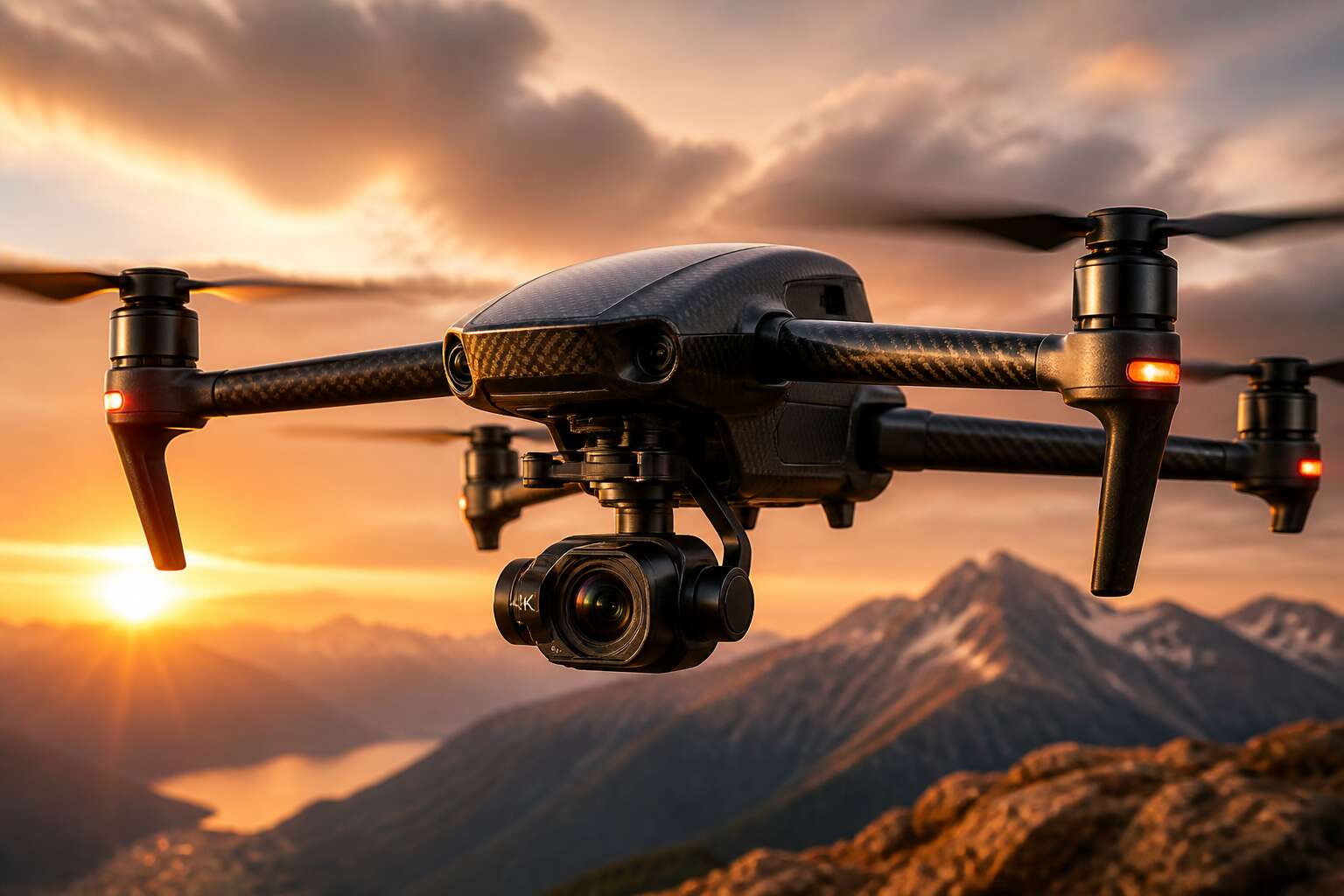
Understanding Modern Aerial Imaging Technology
Evolution of Consumer Drone Technology
The first camera drones were little more than nimble toys with a GoPro strapped to the top. I’ve watched that scene change completely. Modern sensors, better gimbals, and smarter software have turned a weekend novelty into a serious tool. In fact, I’ve seen a 2024 model follow a mountain biker through a forest, avoiding branches on its own.
This evolution matters far beyond flashy footage. Aerial imaging now feeds precision agriculture, where a vineyard in the Cape can be scanned for disease before a human walks a single row. The shift is about dependable hardware. That reliability opens doors for surveyors, electricians, and ordinary hikers.
- Obstacle avoidance is now omnidirectional
- Transmission range has doubled in two generations
- Camera stabilisation happens inside the lens
Camera drones 2024 feel less like a hobby and more like a standard piece of gear.
Key Differences Between Consumer and Professional Models
A single camera drone 2024 with a full-frame sensor costs more than a used bakkie. That price gap separates two philosophies. Consumer models assume a perfect day, a single flight, and a quick edit. Professional models assume variable wind, failed GPS, and a client who needs the same shot tomorrow.
- Consumer gimbals correct drift; professional gimbals hold a programmed arc.
- Consumer images get compressed in the air; professional models record raw logs.
- Consumer obstacle avoidance reacts; professional systems plan a path.
That distinction changes how you fly. A consumer pilot thinks in minutes. A professional thinks in missions, batteries, and redundancy. For a South African operation, from the Karoo to the coast, the difference is not the camera. It is the margin for error. The camera drones 2024 market offers both, but only one of them forgives a mistake when the wind turns.
Emerging Trends in Autonomous Flight Features
Modern aerial imaging depends on sensor fusion. Camera drones 2024 capture more light and detail than earlier models, yet the real progress sits in on-board processing. The drone evaluates a scene before you review it, merging highlight and shadow data in real time. That changes what a single flight can deliver, especially under South African light conditions.
Autonomous flight features follow this logic. Simple obstacle avoidance has given way to systems that map entire environments. The craft tracks moving animals, reads wind shifts, and recalculates routes without input. For farmers inspecting vast stretches of Karoo veld, this reduces repetitive manual control.
- Real-time terrain mapping for irrigation planning
- Multi-directional collision sensing in dense bush
- Automated subject lock for wildlife counting
These tools extend pilot capability without replacing judgement. The camera records, but the autonomy decides how to get there.
How Artificial Intelligence Enhances Aerial Filming
The real shift in aerial imaging is how much computation happens inside the drone. A camera drone 2024 packs a stacked sensor that reads each pixel twice, capturing a long exposure for shadows and a short one for highlights. The processor merges those reads before anything reaches the memory card. In harsh midday light, you no longer choose between sky and ground detail.
Artificial intelligence enhances filming itself, not just navigation. The drone’s AI interprets the scene before you press record. It reads faces, animals, and vehicles in the frame, then adjusts focus and exposure continuously. This means you can focus on framing the shot instead of watching aperture settings.
- Real-time subject tracking for fast-moving wildlife
- Automatic focus pull between foreground and distant subjects
- Intelligent exposure alignment for mixed shadow and sun
These functions run in real time on camera drones 2024, changing what a single flight delivers.
Selecting the Ideal Drone for Your Photography Needs
Assessing Your Skill Level and Budget Range
Of the many conversations I have had with photographers this year, the most telling ones begin not with a question about megapixels, but with a confession about unused features. You see, the cacophony of marketing for the camera drones 2024 lineup is loud, but the reality of your own cockpit is quieter. The ideal purchase hinges on an honest audit of your thumbs and your wallet, not on the spec sheet’s poetry.
Determining your place on the skill spectrum is the first act of fiscal prudence. A neophyte who buys a high-end rig with omnidirectional sensors will likely spend more time in the settings menu than scouting locations. That advanced obstacle avoidance is a sophisticated safety net, but it can also foster a lazy eye for composition. Conversely, the seasoned pilot will find the automated modes in entry-level models to be restrictive, feeling less like a tool and more like a straitjacket for their visual instincts.
Your budget range dictates the available compromises. It is a simple law of the marketplace. However, a common oversight is to look only at the price tag on the box, ignoring the ongoing costs. As you map your expenditure for a new system, remember that you are not buying a single gadget, but entering a long term relationship. Consider these essential companions:
– Spare batteries, which are an absolute necessity for any serious session.
– A hard case for transport that does not crumble at the first sign of a gravel road.
– Additional ND filters to tame the harsh South African midday sun.
– A faster memory card, since 4K footage eats storage space with a fierce appetite.
The chasm between a “good” and a “great” purchase often lies in the honesty of this self assessment. The heavy lifting of a professional career requires a robust payload capacity, but a travel vlogger might prefer a sub-250g model that slips into a daypack without drama. The market for camera drones 2024 offers a broad spectrum, but the specific sweet spot for you exists at the intersection of your current skill ceiling and your realistic financial floor. Ignoring one for the other is a recipe for a very expensive paperweight, or a very frustrating flying session.
Comparing Gimbal Stabilization Systems
The gimbal is the unsung architect of every crisp frame you capture. When selecting the ideal drone for your photography needs, the stabilization system deserves more scrutiny than the camera sensor itself. A 3-axis mechanical gimbal absorbs the drone’s micro-vibrations and wind-induced tremors, while electronic stabilization merely crops into your footage, silently stealing resolution. For South African conditions, where afternoon gusts roll off the Drakensberg without warning, a robust mechanical gimbal is your only true ally.
Compare these elements before you commit to any camera drones 2024 model:
– The number of axes actively stabilized.
– The gimbal’s response speed to sudden aircraft movement.
– Whether the camera tilt range allows for full vertical sweeps.
A slower, smoother gimbal can outshine a higher-resolution camera on a shaky rig. Test the hover stability indoors, then trust your eyes, not the marketing sheet.
Evaluating Flight Time and Battery Performance
On the Highveld, thin air can slash your drone’s flight time by 25 percent. That reality shapes every battery decision for camera drones 2024. Most consumer models hover between 20 and 40 minutes, but wind resistance, payload weight, and altitude cut that number sharply. Battery life remains the most tangible constraint for any aerial photographer.
When evaluating performance, look beyond advertised minutes. The battery’s discharge rate, measured in C-ratings, determines how well it copes with aggressive manoeuvres.
Useful metrics to inspect before purchase:
- Flight time measured under realistic conditions, not lab settings.
- Charge cycle endurance, typically 150 to 300 cycles before capacity fades.
- Hot-swap capability for longer shoots without landing.
Batteries for camera drones 2024 often require specialised charging hubs, and those hubs add to the overall cost.
Portability Versus Camera Capability Trade-offs
The best camera drones 2024 force a simple compromise. A foldable model with a one inch sensor fits in a daypack, while a heavier quad with a Micro Four Thirds camera delivers richer files. On the Cape Town trails, I have seen photographers choose the lighter option and regret it at dusk.
Consider these trade-offs before you buy:
- Sensor size versus payload weight
- Fixed lens versus interchangeable system
- Folding arms versus structural rigidity
A compact model still produces sharp social media shots, but dynamic range takes a hit. The portability advantage only matters if the drone leaves your carry bag. That is the real calculation.
Warranty and After-Sales Support Considerations
Nobody notices a warranty until the gimbal motor seizes on a Tuesday afternoon. Then the fine print becomes the only thing that matters. For camera drones 2024, after-sales experiences vary wildly between brands. South African buyers face extra complexity with international shipping and repair timelines that stretch for months.
I have learned to ask specific questions before purchasing! What does the warranty cover? Crash damage, or only manufacturing defects? Where does the unit ship for repairs? Local service centres in Johannesburg or Cape Town change everything.
Evaluate these warranty factors:
- Coverage for water damage and bird strikes
- Replacement unit availability during repairs
- Battery warranty terms, since cells degrade faster in heat
- Software update commitments after expiry
Firmware obsolescence can ground a drone when a manufacturer pushes a mandatory update. The camera drones 2024 worth owning are backed by support systems that respond.
Critical Camera Specifications to Look For
Sensor Size and Resolution: From 1/2.3-Inch to Full-Frame
The sensor size defines aerial imaging, yet many buyers focus only on megapixels. For camera drones 2024, the gap between small and large sensors is massive.
A 1/2.3-inch sensor struggles to balance bright areas and dark areas in harsh noon light. The South African landscape, with its high light and deep shadows, is a brutal test for a drone camera. It blows out the white paint on a roof and loses the details in the shadow under a tree. A one-inch or full-frame sensor preserves detail in both extremes without relying on software to guess what got lost.
Here is what matters on a spec sheet:
– Physical size of the sensor
– Dynamic range (measured in stops)
– Effective megapixels
Consequently, an older 12-megapixel drone with a one-inch sensor will produce cleaner footage than a budget drone with a 20-megapixel half-inch sensor. Resolution is just the number of pixels. Size determines how much real visual information each pixel holds. For camera drones 2024, prioritize the latter.
Aperture, Shutter Speed, and Manual Control Options
Most pilots never touch manual exposure. That is a mistake! A fixed aperture and auto shutter will fail you the moment a cloud passes over the Karoo. For camera drones 2024, manual control is not a luxury. It is the difference between a usable frame and a ruined one.
Check for adjustable aperture. A variable f/1.8 to f/2.8 lets you control depth of field and light intake. Shutter speed matters too. Fast speeds freeze motion, slow speeds create motion blur. You need both options.
- Manual ISO and shutter speed
- Histogram and zebra overlays
- Exposure lock and bracketing
Without these, you depend on the algorithm. That works for casual shots, not for serious work.
Dynamic Range and Color Profile Capabilities
Dynamic range is the first thing I check on a drone’s spec sheet. A camera that claims 12 stops but clips a Karoo sunset into flat orange has failed the test. In camera drones 2024, you want a sensor that holds shadow detail and highlight texture across a single frame. That latitude gives you room to grade without banding or noise.
Color profile capabilities matter equally. A flat or LOG profile captures more tonal information, but only if the codec supports 10-bit depth. Without that, you compress nuance away. Look for custom white balance and a wide gamut option. These settings turn a good camera into a predictable companion.
Consider how the profile renders skin tones and foliage. Some drones produce greens with a digital sheen that flatters nothing. A profile that preserves natural hues is worth more than a long spec list. I prefer a histogram and a reliable monitor. The rest is trust.
Optical Zoom Versus Digital Zoom Considerations
Everything about zoom in camera drones 2024 is a marketing battle. The spec sheet screams 100x zoom, but the physics behind that number is where the truth hides. Optical zoom uses glass to magnify the scene before the sensor captures it. Digital zoom crops into the image you already have. One retains detail, the other pretends to.
For a practical example, consider the difference between seeing a rhino at 200 meters versus a dusty pixel that vaguely resembles one. Optical zoom brings the rhino to you. Digital zoom asks you to imagine the rhino. Most consumer drones offer a fixed lens with digital zoom options, so you are effectively cropping in post flight. That works fine for social media, but it fails for print or serious editing.
The tradeoff appears in the field. A drone with true optical zoom adds weight and cost, but it maintains resolution. Digital zoom is free software, yet it multiplies noise and softens the frame. Here is what to consider when reading those zoom numbers:
- Check if the zoom is lossless at 4K or 1080p resolution.
- Focal length determines the field of view, not the marketing term.
- Hybrid zoom blends optical and digital, but the digital portion still degrades.
The pitfall is the middle ground. Many specs claim 4x zoom, but that is often a hybrid mix. The first 2x might be optical, the rest is a crop with software sharpening. For the South African landscape, where the Karoo demands wide vistas and wildlife requires reach, know what you are buying before you chase a distant kudu. Digital zoom has its place, but that place is not a substitute for glass.
Low-Light Performance and Night Shooting Modes
The truth about low light is not written in megapixels. It is written in the sensor’s ability to drink in photons and hold them without screaming. For camera drones 2024, the real measure is ISO performance, specifically how high you can push the gain before noise devours the detail. A sensor with large individual pixels collects more light. That is the only fact that matters when the sun dies and the bush turns to shadow.
Night shooting modes have become the new battleground for camera drones 2024. Some flagships now feature a dedicated night mode that stacks multiple frames in real time, reducing noise and pulling color from the dark. These modes require a stable hover, so gimbal technology and obstacle avoidance become co-conspirators in your image capture. The best systems allow manual shutter control, letting you drag the exposure for light trails or city glow.
The specific specs worth hunting for are not the advertised low light claims. Look at the native ISO range, the aperture blade count, and whether the sensor uses a backside illuminated design. For South African skies, where the Milky Way is a common visitor, you want a drone that keeps its noise low before software ever gets a chance to clean things up.
Top-Performing Drones Leading the Current Market
Best Budget-Friendly Options for Beginners
Around 38 million camera drones were sold last year, and camera drones 2024 models are pushing that figure higher. At the premium end, the DJI Mavic 3 Pro and Skydio 2+ lead with computational imaging and obstacle avoidance. They are not cheap, but they earn their price in difficult light and cramped environments.
Budget buyers should not feel shortchanged. The Hubsan Zino Pro and Holy Stone HS720G fly solidly for under R3000. Their 4K cameras do not match flagship sensors, but they capture usable footage for social media and family trips.
- DJI Mini 4K packs a stable gimbal into a 249g frame.
- The Potensic T25 offers GPS and a 2.7K lens for under R2000.
These options let beginners learn without fear of a costly crash.
Mid-Range Drones with Advanced Camera Features
Between entry-level models and professional cinema rigs sits a capable middle tier. The DJI Air 3 and Autel EVO Lite Pro carry dual optical lenses and adjustable apertures, letting pilots shoot shallow depth of field over Table Mountain without taking a second bond. These mid-range models record 10-bit D-Log M and HLG profiles, preserving highlight detail in graded footage. Creative control peaks here in camera drones 2024.
The shortlist for advanced camera features:
- Dual native ISO for clean low-light clips
- 3-axis mechanical gimbal with horizon leveling
- 20MP stills with raw burst capture
Skydio 2+ remains the autonomous champion, but its color science trails this tier.
Professional-Grade Drones for Commercial Filmmakers
Top-performing camera drones 2024 have shifted the baseline for commercial work. The Inspire 3 remains the reference point for crews shooting on location, though its price demands a serious production budget. Its full-frame sensor and interchangeable lenses deliver a dynamic range that consumer rigs simply cannot match. The Mavic 3 Pro Cine sits below it, offering a smaller footprint without compromising on ProRes recording.
For commercial filmmakers, reliability matters as much as image quality.
Here is what separates professional loadouts from enthusiast gear:
– Redundant flight controllers and dual GPS modules
– Uncompressed video output via SDI or ethernet
– Adjustable aperture lenses across multiple focal lengths
– Timecode synchronization for multi-camera shoots
Those features justify the cost when you are shooting a commercial in Cape Town and cannot afford a lost take. The Autel Evo Max 4T also deserves mention for its thermal imaging capabilities, though its software ecosystem still feels less polished than DJI’s. When you need to deliver broadcast-ready footage without renegotiating with the client, these professional drones earn their keep. They are tools, not toys, and they price themselves accordingly.
Compact and Foldable Models for Travelers
For travelers, the best camera drones 2024 are the ones that slip into a daypack without a second thought. The DJI Mini 4 Pro weighs under 250 grams, which matters when you are hiking Table Mountain or exploring the Garden Route. Its vertical shooting mode works well for social media, and the obstacle sensing is genuinely useful in tight spaces. The Hover Air X1 takes a different approach. It folds flat like a smartphone and follows you without a controller. That simplicity appeals to solo travelers who want a shot without fumbling with settings.
Portability, however, comes with compromises. Smaller sensors struggle in low light, and wind resistance varies significantly between models. When you are planning a trip to the Karoo or the coast, check these details before buying:
– Wind speed tolerance for coastal conditions
– ND filter availability for bright daylight
– Spare battery cost and charging time
– Local CAA registration requirements for foreign travel
Foldable models have matured. They now offer 4K video, reasonable dynamic range, and flight times around 30 minutes. The trade-off is real, but for most travelers, the convenience outweighs the limitations.
FPV Drones for Immersive First-Person Shots
Performance leaders set the standard for everyone else, and the DJI Air 3 demonstrates why it dominates the mid-range market. Its dual-camera system, combining a wide lens with a 3x telephoto, changes how you approach a shoot. You can frame a subject from a distance without sacrificing detail, which matters when you cannot get closer. This model balances flight characteristics with practical camera features, making it the reference point for camera drones 2024.
The shift toward FPV drones introduces a different set of priorities. An immersive first-person view requires a skill set that is not about perfect composition. It is about reaction time and spatial awareness. The DJI Avata 2 offers a gentle learning curve for pilots moving from traditional sticks to motion control, but the real value is in the footage. High-speed passes through natural landscapes like the Cederberg create sequences that static hover shots cannot match.
Flying FPV demands specific commitments from the pilot:
- Mastering the throttle and pitch coordination
- Understanding the terrain before you fly, not after
- Investing in spare propellers and arms for inevitable contact
These drones are tools for a specific kind of storytelling, one that prioritizes motion over static detail.
Legal Requirements and Flight Safety Best Practices
Mandatory Registration and Pilot Certification
Flying camera drones 2024 in South Africa involves obligations that go far beyond picking a scenic location. Every operator must register their aircraft with the South African Civil Aviation Authority (SACAA), while commercial work requires a Remote Pilot Licence under Part 921. Insurance is mandatory for professional assignments, and regulators actively inspect compliance at major events and urban shoots.
Before every flight, pilots must verify airspace restrictions, confirm visual line of sight, and respect altitude limits. The law requires:
– Remaining below 120 metres above ground level
– Keeping at least 50 metres from people and properties
– Giving way to all manned aircraft without exception
Ignoring these rules invites severe penalties and possible criminal liability. For camera drones 2024, this legal framework shapes every shoot, from Cape Town’s coastal cliffs to Johannesburg’s skyline. Local bylaws differ between municipalities, so checking district regulations is just as essential as studying national statutes. A disciplined pre-flight routine protects your licence, your equipment, and your future as a pilot.
Understanding Remote ID Requirements
Revealed in Miniature: every motorised aircraft above 250 grams now broadcasts a digital signature. Remote ID transforms your camera drones 2024 into a cooperative participant in South African airspace, a silent beacon readable by authorities and other aviators. This mandate replaces anonymity with accountability, ensuring that every flight leaves a data trail across the ether.
The system transmits identification, location, and velocity without requiring any manual input from the operator. No physical module is visible on most contemporary models, as manufacturers have woven the transponder directly into the flight controller architecture. Pilots must confirm their drone’s Remote ID compliance before initiating the pre-flight checklist, as a silent aircraft is effectively grounded under current regulations.
What this technology communicates is straightforward:
– Aircraft serial number and operator registration details
– Real-time GPS coordinates of the drone and the controller
– An altitude and speed reading, updated every second
This broadcast becomes critical near OR Tambo’s approach paths and the restricted zones circling our nuclear facilities. Deliberate deactivation of Remote ID carries the same punitive weight as flying without registration. For camera drones 2024 operators, this silent transmission is the price of entry into a shared sky, a constant whisper that keeps every aerial assignment within the bounds of lawful operation.
Navigating Restricted Airspace and No-Fly Zones
South Africa logged over 1,200 drone incursions near restricted airspace in the past three years. That number includes operators who believed their GPS warnings would prevent a violation. The SACAA’s interactive map shows the real boundaries, which shift with construction and changing flight paths. I check this map before every assignment. A single transgression could ground camera drones 2024 operations for everyone involved!
Regulations divide South African airspace into clear categories:
- Restricted zones require prior permission from Air Traffic Control
- No-fly zones over prisons, military bases, and national key points are absolute
- Temporary flight restrictions appear during VIP movements or major events
Flying near a crowd in Sandton demands the same diligence as flying over a game reserve. The rules do not distinguish between hobby and commercial intent, and they apply equally to camera drones 2024. A pilot who ignores a restriction compromises the reputation of every operator in the country.
Privacy Considerations When Recording in Public
South Africa’s Protection of Personal Information Act (POPIA) turns every flight into a legal balancing act. I always remind clients that recording strangers with camera drones 2024 demands more than a steady hand. The public’s reasonable expectation of privacy shifts depending on location, time, and context.
- Private gardens and hotel balconies remain protected zones.
- Beach scenes require extra care during peak hours.
- Street interviews need explicit verbal consent.
Flight safety and privacy overlap more than pilots expect. Maintaining a wide berth from windows and gathering spots reduces accidental intrusion. Ground observers often judge drone behaviour by noise and proximity, not legal intent. A calm, deliberate flight path builds trust.
Securing Adequate Insurance Coverage
That trust, however, has a price. South African law does not yet require insurance for camera drones 2024, but the country’s civil courts have little patience for pilots who fly with empty pockets. A distracted moment over a suburban pool can yield a claim that makes the drone’s purchase price look like pocket change.
Flight safety practices reduce those moments. Maintain a generous distance from windows, vehicles, and gatherings. Perform a pre-flight check that covers rotor integrity, battery temperature, and control-link strength. If you accept payment for your work, inform your broker. A personal policy quietly becomes void the moment a handshake exchange occurs.
An adequate policy should cover:
- Third-party bodily injury and property damage
- Loss or theft of the drone and its camera
- Public liability for ground observers
Exclusions matter. Many policies void coverage for flights that breach CAA rules, so a flyaway after a careless flight becomes a personal expense.
Weather Conditions and Pre-Flight Inspection Checklists
South African law treats camera drones 2024 as regulated aircraft. The Civil Aviation Authority expects pilots to maintain visual line of sight, respect altitude limits, and avoid flying over people or property without permission. Weather complicates that duty. Wind speeds above 25 km/h test even confident pilots, and coastal thermals shift without warning. Check cloud ceilings, visibility, and heat. Electronics overheat faster under the Highveld sun.
A pre-flight inspection checklist for camera drones 2024 prevents avoidable failures. Confirm propellers are free of cracks, batteries sit at optimal temperature, and the compass calibrates away from metal structures. Also verify controller signal strength, and run through these basics:
- Camera lens cleanliness
- Gimbal movement
- Firmware updates
- Spare propellers
Weather and inspection discipline work together. No pilot outflies a dead battery or a sudden gust. The CAA can demand flight records at any time.
Enhancing Your Aerial Photography and Videography Workflow
Planning the Perfect Shot with Automated Flight Paths
Planning the perfect shot with automated flight paths separates a lucky capture from a deliberate one. Camera drones 2024 let you plot waypoints on a digital map, then hand control to the flight controller. The drone repeats the route with consistency, which matters when you chase the same light across multiple sessions.
I often sketch the route on a tablet before launching. I adjust the aircraft altitude at each waypoint, set the gimbal angle, and decide when the camera starts recording. Some models even let you refine the path after the first pass, which means you can correct a framing issue without returning to the start.
- Waypoint sequencing determines how the drone moves between subjects.
- Gimbal synchronization keeps the lens locked on a moving target.
- Speed control shapes the pacing of the reveal.
That level of planning turns a standard flight into a repeatable sequence, giving you more time to watch the scene unfold.
Using Neutral Density Filters for Cinematic Shots
Neutral density filters control light exposure, which is essential for cinematic drone work. On camera drones 2024, I attach an ND filter before takeoff to manage the intensity of sunlight. This simple step keeps highlights from clipping and preserves texture in clouds or white buildings. My routine starts by checking the ambient light, then choosing the filter that brings the exposure into a safe range.
A practical kit covers common conditions:
– ND8 for bright overcast days
– ND64 for direct sunlight
– ND1000 for long exposures
I swap filters on the ground between flights rather than mid-air. The strength you choose shapes the final look, so I carry spares in a small case. This workflow becomes automatic, and it prevents the disappointment of landing with unusable footage.
Post-Processing Workflow: Color Grading and Correction
Sixty percent of the image quality you perceive comes from post-processing, not the sensor. The footage you bring back is a starting point, not a finished product. Every raw file contains more color information than your screen can show, and that extra data gives you a wide range for adjustments. I begin with white balance, because a wrong tint corrupts every adjustment that follows. Then I normalize exposure across clips to avoid jarring shifts between scenes.
For color grading, I work with scopes rather than trusting my monitor. A waveform and vectorscope reveal true luminance and saturation levels. I often rely on a small sequence of steps:
- Set the black point for clean shadows
- Adjust mids to preserve detail in clouds
- Shape highlights to keep skies dimensional
Correction comes before grading, always. The goal is fidelity, then flavor. Modern camera drones 2024 deliver flat picture profiles that tolerate aggressive manipulation, but only if you respect their limits. Subtlety matters more than spectacle.
Maintaining Your Drone for Longevity and Reliability
Enhancing your aerial workflow means treating the ground work as seriously as the flight. I log every sortie, noting wind direction and exposure settings. Those notes become a reference library. When I review footage, I compare against that log to see what worked. The same discipline applies to hardware. Camera drones 2024 pack more electronics into smaller frames, which makes preventative care essential.
I follow a simple inspection routine:
- Check propellers for nicks and cracks
- Clean the gimbal with a soft brush
- Update firmware before important shoots
Battery care affects longevity. Store packs at storage voltage and avoid deep discharges. Corrosion on contacts causes intermittent failures. A drone that flies reliably every time is worth keeping. Neglect shows up on the footage before it shows up on the dashboard.

0 Comments